Travel Light #3: don't be creative: participate instead
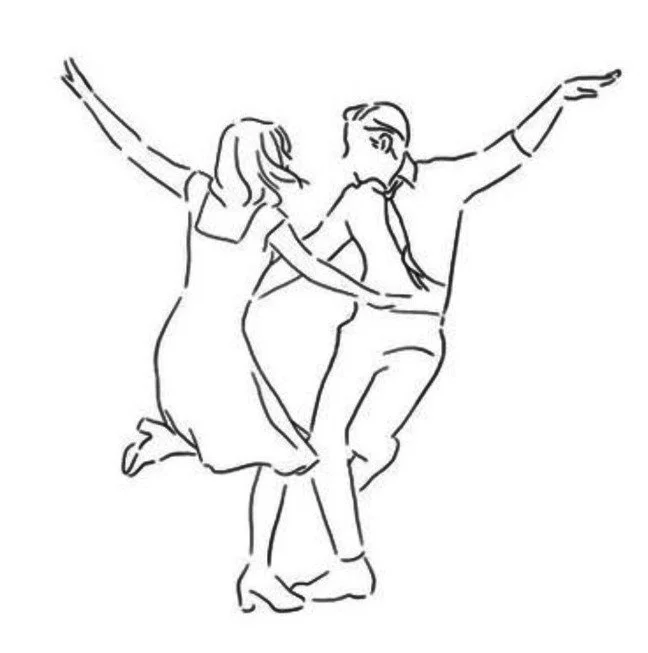
“Your style doesn't have to be invented; it can emerge.”
Over the years, partly due to social media, I've noticed the intense pressure people place on themselves to "get it right," to demonstrate their creativity from the outset. Social media enables us to build a public identity before we've had time to develop a private practice. We're encouraged to appear expert before acquiring skills, performing expertise before we've had time to cultivate it.
This pressure can have the opposite effect of what creativity requires. Instead of relaxing into curiosity and exploration, we start worrying about how our efforts will be perceived by others. When embarking on any creative venture, it's beneficial to maintain an open curiosity, to embrace the role of a student, and to cultivate what is often called a beginner's mind.
Because I believe the word "creative" is so overloaded with judgment and comparison, I want to offer an alternative approach. In my first blog, I suggested asking a different question: "What does my creative impulse want me to explore?" In this blog, I want to take that idea a step further and examine how we might navigate a creative project, or perhaps a creative life.
Here is an acronym to help: PEEC. In whatever art form you choose, think of creativity not as an identity you must earn, but as something you do. Creativity is a verb.
1. Participate
Let go of trying to be creative. You might protest, "But I want to be creative!" You'll get there. For now, embrace being a true amateur when you begin something.
In English, the word "amateur" has acquired a somewhat pejorative tone. It can imply incompetence, a dabbler, or someone lacking professional training. However, "amateur" comes from the French amateur, from the Latin amatorem, meaning "lover" or "friend." In French and other Romance languages, amateur can carry a much more positive or neutral meaning: someone who loves or is passionate about something. I believe we can reclaim that meaning. An amateur is someone who participates because they love something.
Trying to professionalize a creative practice too early can transform curiosity into performance. There will be ample time to refine your skills and become a professional if you choose to.
When I first started learning Lindy Hop, a form of swing dancing, I didn't begin because I wanted to become a dancer. I didn't even know if I could dance. I simply saw people dancing to live swing music, enjoying themselves, and thought, "I'd like to be part of that." There was apprehension, doubt, and plenty of questioning about whether I could actually learn the dance, but telling myself I was there to participate, regardless of how I danced, made the first step easier. I didn't have to be a dancer; I just had to dance.
When you give yourself permission to be an amateur willing to participate, you set the stage for what comes next.
2. Emulate
Once you're in the room, learn. In my playwriting workshops, I emphasize learning the fundamental techniques of drama before creating one's own work. I do something similar when I work with entrepreneurs: learn the rules.
In both groups, some participants resist this. They want to do things their own way immediately. My response is usually the same: emulate. Copy. Observe. Try it the way someone else has shown you. Although I eventually want participants to break the rules, I want them to know which rule they are breaking.
We sometimes have a strange idea that imitation is the opposite of creativity, but most creative learning begins this way.
There's another layer of resistance that can stop us in our tracks. It sounds something like: "Everyone is going to see how foolish I look when I attempt to dance, or paint, or write, or play, or whatever it is I'm trying to do." But we heavily overestimate how much other people notice, scrutinize, and judge us. Psychologists call this the spotlight effect. We imagine that everyone is watching us. Most people are too busy worrying about themselves. As Olin Miller put it, "You'd worry far less about what people thought of you if you only knew how rarely they do."
I experienced this firsthand with Lindy Hop. I took quite a few basic classes and realized that looking awkward and silly at times was simply part of learning. I was surrounded by other beginners who were also figuring it out. We made mistakes. We laughed at ourselves. And humor turned out to be a wonderful antidote to self-consciousness. There was something liberating about realizing that I didn't have to look like a dancer while I was learning to dance.
3. Experiment
Once you've participated and learned by emulating others, you have something to play with. This is where experimentation begins, and this is where you can start adding your own spin, without making "finding your unique voice" another performance obligation.
Your style doesn't have to be invented; it can emerge.
Experimenting is where you begin to notice what you like, what interests you, what feels natural, what you want to repeat, what you want to change. Find an outlet to practice consistently, without worrying about the outcome. Cook a new meal every Friday. Play the guitar before you go to bed. Take photographs on your walk.
The point isn't to produce something impressive. The point is to do the thing often enough to discover what you have to say through it. The techniques you learned in the Emulate phase give you something to work with. Experimentation allows your preferences, personality, and perspective to enter the mix.
This was the phase I particularly enjoyed in Lindy Hop. I had the opportunity to experiment at weekly socials, often dancing to a live swing band. Through much trial and error, I began to understand the craft, and slowly, to add my own spin. I wasn't trying to invent a new dance; I was discovering how I wanted to dance it.
4. Craft
Eventually, the amateur in you progresses. You know more. You notice more. You become more discerning. You want to get better. This is where craft enters the picture.
After a while, I began taking intermediate Lindy Hop workshops, traveling to different cities, and attending weekend bootcamps. Some of my colleagues eventually went on to become instructors, and that's perfectly possible too.
At this stage, you may decide to professionalize your craft. You may want to teach, publish, perform, sell, or build a business around what you do. There is nothing wrong with that. The question is simply: what brought you there in the first place? If professional success becomes the only measure, it's easy to lose touch with the original curiosity and love that got you started.
The amateur and the professional don't have to be enemies. In fact, I think the best professionals retain something of the amateur: the person who is still curious, still learning, still willing to be surprised.
That's the beauty of PEEC: Participate. Emulate. Experiment. Craft. You don't have to arrive as a creative person. You participate first. You learn. You play. You practice. And somewhere along the way, you begin to develop a voice of your own.
Perhaps that's what creativity really asks of us—not to be creative, but to keep doing the things that allow creativity to emerge. And maybe PEEC is simply an invitation to create your own creative piece while remaining at peace with yourself along the way.
The Unexpected Thread
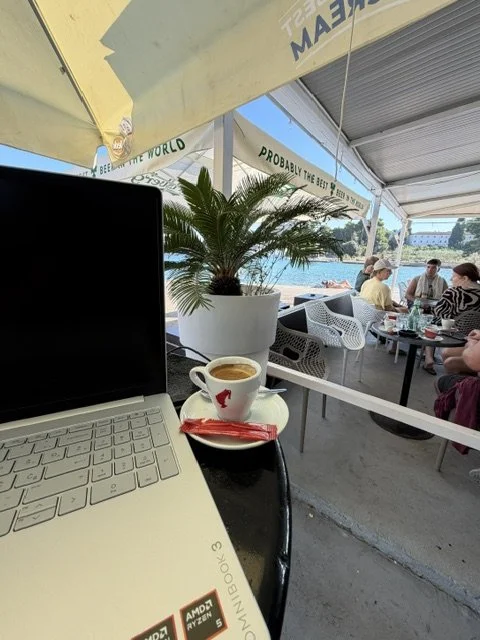
My go-to cafe whenever I'm on the island Ugljan, Croatia
Each summer, I stay in a small village on an island in Croatia where my parents are from. It's a tourist destination in the summer months and a sleepy town in the off-season. Although I've been there many times, living the "pomalo" (super chill) life, I hang out and write my blogs at some of my favorite cafes, alternating whatever the mood strikes me.
And I notice the tourists, and see my village through their eyes. They notice things. They ask questions. They get lost. They don't know the shortcuts. They might order the wrong thing from the menu or photograph the morning sunrise that local people walk past every day without noticing. They are curious because they haven't yet learned what you're "supposed" to ignore.
That's one of the gifts of being a tourist. They haven't become an insider yet. And perhaps that is something worth remembering when we approach creative work.
We put enormous pressure on ourselves to become experts, to develop a style, establish a voice, and know what we're doing. But what if, instead, we allowed ourselves to remain tourists? To enter unfamiliar territory without immediately needing to belong. To look closely. To ask naive questions. To get things wrong. To follow our curiosity down a street we've never walked before.
It reminds me of when I first walked into a Lindy Hop class: I was a tourist. I didn't know the language of the dance. I didn't know the steps. I didn't know the etiquette. I didn't know what I was doing. I simply knew that something about it attracted me. I wanted to be part of it.
Maybe that's enough of a reason to begin anything creative. You don't have to know where you're going. You don't have to have a style. You don't even have to call yourself creative. Just be willing to participate. To stay curious.
Stay a little lost. Be a tourist in your own creative life.
Till next time. Travel light.
