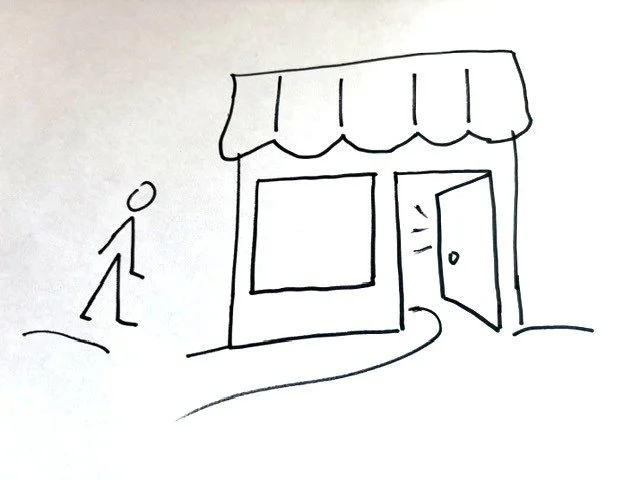
Step inside to see what’s possible.
An opportunity is like looking through the window of an interesting store. You get a glimpse of what's inside, but you're not entirely sure what to expect. You take a chance and walk in. Some things are just as you imagined. Others are unexpected surprises.
Then you notice something else. There are windows into adjacent stores that you couldn't see from the street. It's a bit like wandering into Diagon Alley in a Harry Potter movie, discovering an entire world that wasn't visible from the outside.
You wouldn't have known those other stores existed had you not walked into the first one.
When I first ventured into the world of theatre, I had an inclination that I'd like to direct a play. I'd never done one before (my background was in coaching entrepreneurs, after all). After taking the leap and directing my first play, I became curious about how scripts worked and decided to write one of my own. Then I explored other formats and discovered the ten-minute play. That led me to another opportunity: producing a small festival based on the ten-minute play format. Eventually, the festival grew to feature more than 24 plays each season.
We tend to think of opportunities as things that appear in front of us, waiting to be recognized and seized. And sometimes they do. But some of the most fascinating opportunities emerge only after we've taken a step. One thing leads to another. We make a connection, discover something unexpected, and suddenly find ourselves somewhere we hadn't imagined.
I would never have imagined creating a festival when I first decided to direct a play. It wasn't part of some grand plan. It emerged from following one interest, discovering another, and being curious enough to explore it.
One opportunity can reveal another.
Following these threads requires us to develop an experimental muscle. This is where entrepreneurial thinking comes in. Not necessarily starting a business, but being willing to act on an inclination, explore a possibility, and see what emerges. It's curiosity-in-action. Rather than needing to know where something will lead, we're willing to take a step and learn from what happens.
The unexpected thread
At one point, I wondered whether I could turn the festival into some kind of franchise model, replicating it in other cities. I looked into it and realized not only was the idea impractical, but it went against the very essence of what I was trying to achieve: offering more opportunities for theatre artists to participate, without the pressure of turning the festival into a business.
Not every opportunity that looks attractive serves the reason we started in the first place. Some experiments run their course. Others reveal that our initial enthusiasm was misplaced. And that's perfectly fine. The point isn't to make every opportunity work. It's to discover what happens when we explore it.
Entrepreneurial thinking is also about knowing when to stop.
In my work as an entrepreneur's coach, I've seen people start businesses hoping to get their artistic needs met. Sometimes this can lead to disappointment. There's a difference between creating something because you feel compelled to make it and creating something because someone needs or wants it. A business needs to serve its customers. An artist, meanwhile, is compelled to serve the work itself. These motivations can coexist, but they aren't necessarily the same.
Ultimately, entrepreneurial thinking means holding our expectations lightly. We may have an idea of where an opportunity will lead, but we need to remain open to where it actually takes us.
What if an opportunity isn't necessarily something to pursue, but something to explore?
Till next time. Travel light.
